We offer classes in the tradition of Roots Herbalism - the kind where your hands get dirty as you develop life-long relationships with plants. Our classroom is the outdoors - garden, forest, field, mountain, and stream. We hold no indoor classes except during inclement weather or insect challenges.
Learning about the plants
in person, where they grow, engages the senses as we smell, touch, see,
and often taste our green allies. This intimate and holistic approach
helps us to integrate all we learn about plants as food and medicine.
Blending spirituality and the study of life, we honor the traditions of
our elders as well as useful knowledge gained through scientific
exploration. Reverence for the sacredness of all life is part of our
guiding philosophy and inspiration.
Our model of
teaching involves experiential or hands-on learning. Rather than simply
talking about a wild plant as food, we spend time together gathering
wild edibles and preparing vital, delicious meals...
[
Read More ]
We offer classes in the tradition of Roots Herbalism - the kind where your hands get dirty as you develop life-long relationships with plants. Our classroom is the outdoors - garden, forest, field, mountain, and stream. We hold no indoor classes except during inclement weather or insect challenges.
Learning about the plants
in person, where they grow, engages the senses as we smell, touch, see,
and often taste our green allies. This intimate and holistic approach
helps us to integrate all we learn about plants as food and medicine.
Blending spirituality and the study of life, we honor the traditions of
our elders as well as useful knowledge gained through scientific
exploration. Reverence for the sacredness of all life is part of our
guiding philosophy and inspiration.
Our model of
teaching involves experiential or hands-on learning. Rather than simply
talking about a wild plant as food, we spend time together gathering
wild edibles and preparing vital, delicious meals. We learn sustainable
wildcrafting through the many hours spent on field trips ethically
gathering wild medicinals and preparing tinctures, teas, and oils.
Students will complete our program with a full natural medicine chest
created by their own hands from fresh bioregional or organically grown
herbs.
We do not limit our focus to medical herbalism,
but instead offer a total plant experience through our study of Botany,
Sustainable Wildcrafting, Plant Ecology, Plant Identification, Wild
Foods, Organic Gardening, and Permaculture.
Classes are
held partly at the Chestnut School Center and Gardens near Asheville,
NC where Juliet Blankespoor and her partner, Tom, organically grow
vegetables, fruit, native plants, and more than 75 species of medicinal
herbs. The Chestnut School Center and Gardens is located in a pastoral
wooded setting with a rich diversity of native and exotic plant
species. The remainder of our class time is spent exploring the beauty
and extreme botanical diversity of the southern Appalachians as we
visit varied ecosystems on our numerous day-long field trips. Our
programs include field trips where we camp in the forest botanizing,
wildcrafting, making medicine, and eating wild plants and mushrooms.
The
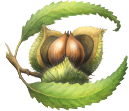
Chestnut School of Herbal Medicine is named after the American chestnut
tree that was once an integral species of the deciduous forests of
eastern North America. In the heart of its range, the Appalachian
Mountains, it is said that one out of every four trees was an American
chestnut with many trees reaching a height of 100 ft. and an average
diameter of 5 feet. Many animals, including humans, were dependant on
their nuts, which fruited abundantly every autumn. Most of the
chestnuts in eastern North America were decimated by the chestnut
blight in the early part of the last century. Many trees still survive
by sprouting from their tenacious roots and growing to a small height,
only to die after they are affected by the blight. A new root sprout
emerges and the cycle of rebirth and death continues. What a powerful
living example of perseverance and regeneration!
This
tree has endeared itself to the hearts of those who devote their days
to its resurgence through the development and/or discovery of
blight-resistant trees - once again a powerful example of people
caring and working for the Earth and her green treasures. May the
chestnuts flourish and fruit abundantly once again and the people
remember the Earth once more!
For more information please visit the American Chestnut Foundations web site at www.acf.org.
[
Show Less ]